
When you are planning a new construction project, whether it is a small home extension or a large-scale commercial development, the focus is often on the architecture, the aesthetics, and the internal layout. However, beneath the surface lies one of the most critical components of any successful planning application: the drainage strategy. In the United Kingdom, where rainfall is a constant factor in our environment, managing surface water runoff is not just a practical necessity but a legal requirement. This is where the BRE365 Infiltration Test comes into play.
Many developers and homeowners find themselves surprised when the local planning authority asks for a specific type of soil test. They might have heard of a percolation test for a septic tank, but a BRE365 test is a different beast entirely. It is a standardised method used to determine if the ground can actually absorb the volume of water generated by new roofs and paved areas during heavy storms. Without this data, your project could face significant delays or even refusal from the Lead Local Flood Authority (LLFA).
What exactly is the BRE Digest 365 standard
The term BRE365 refers to the Building Research Establishment (BRE) Digest 365, which provides the industry-recognised methodology for soakaway design. Unlike simple percolation tests used for foul water drainage, this test is specifically designed for surface water management. The goal is to calculate the soil infiltration rate, which tells engineers how quickly a specific area of ground can dissipate water back into the natural environment.
The philosophy behind this standard is rooted in Sustainable Drainage Systems (SuDS). In years past, we often simply piped rainwater into the nearest sewer. However, our sewer systems are now frequently overwhelmed, leading to increased flood risks. Modern planning policy dictates that we must manage water as close to the source as possible. If your soil is suitable, the preferred method is infiltration. The BRE365 Infiltration Test is the only way to prove to the authorities that your site can handle this approach safely without causing flooding to your own property or your neighbours.
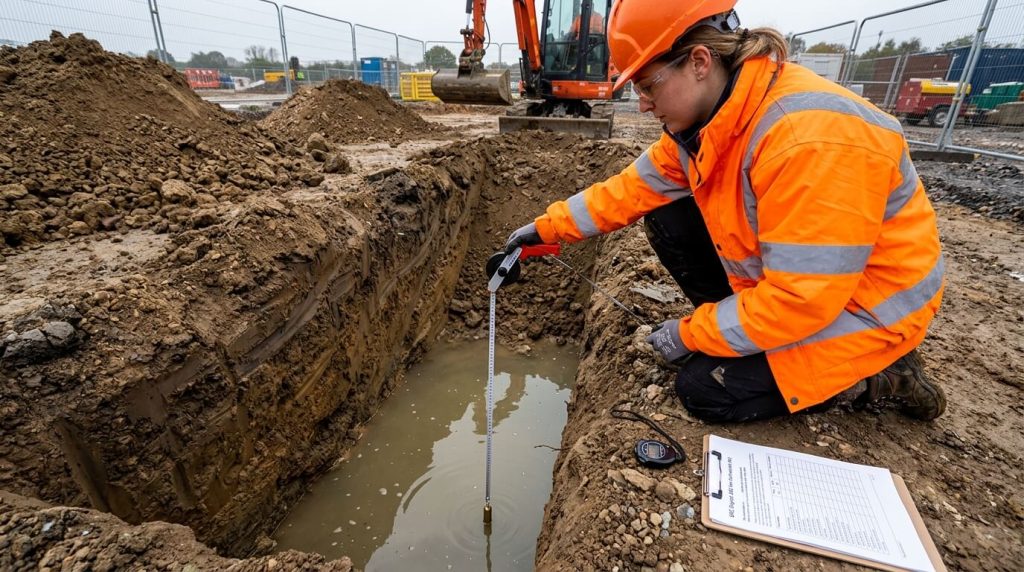
How the testing process works on site
Conducting a proper BRE365 Infiltration Test is a labour-intensive process that requires precision and patience. It is not something that can be completed in an hour. The procedure typically involves the following steps:
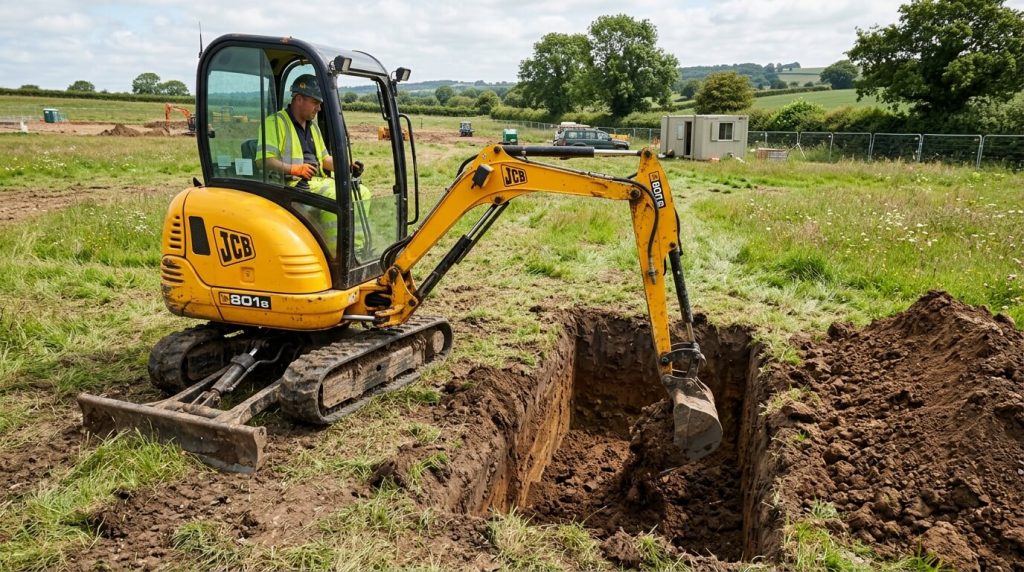
- Excavation of Trial Pits: A machine, usually a mini-digger, is used to excavate a pit to the depth of the proposed soakaway. These pits are typically between 1 and 3 metres deep, depending on the scale of the project and the anticipated soil conditions.
- Measurement and Preparation: The dimensions of the pit are carefully recorded. The sides must be clean and vertical to ensure the water surface area is accurately calculated.
- The Filling Phase: The pit is filled rapidly with water from a large tanker or a high-volume water supply. It is crucial that the pit is filled to its maximum effective depth quickly to simulate a sudden, heavy storm event.
- Monitoring the Drop: The rate at which the water level drops is measured over time. This monitoring continues until the pit is empty or has dropped sufficiently to provide a clear trend.
- The Three-Fill Requirement: This is where many people get caught out. To comply with BRE Digest 365, the test must be repeated three times in quick succession on the same day or consecutive days. This ensures the soil is fully saturated, reflecting how the ground would behave during a prolonged period of wet weather.
Why the three-fill rule is so important
It might seem excessive to fill a hole with water three times, but there is a very sound scientific reason for it. The first time you fill a dry pit, the water often disappears quickly as it fills the voids in the dry soil. This gives a false impression of how the ground will perform during a long British winter. By the third fill, the surrounding soil is saturated, and the infiltration rate usually slows down. This third result is what engineers use for their calculations because it represents the ‘worst-case’ scenario. If your soakaway is designed based on the first fill, it might fail during a week of heavy rain, leading to surface ponding or structural damage.
The challenges of different soil types
The success of a BRE365 Infiltration Test depends entirely on the local geology. In areas with sandy or gravelly soils, the water often drains away rapidly, making the site ideal for simple crate soakaways. However, many parts of the UK are characterised by heavy clay. Clay particles are tiny and pack together tightly, often making them virtually impermeable.
If you are testing in clay, you might find that the water level barely moves over several hours. If the pit does not empty fast enough to complete three fills within a reasonable timeframe, the soil may be deemed unsuitable for infiltration. In these cases, your drainage engineer will need to look at alternative SuDS solutions, such as attenuation tanks that slowly release water into a watercourse or a sewer at a controlled rate. This is why getting the test done early in the design phase is so vital; it dictates exactly what you can and cannot build on your site.
Professional expertise and safety considerations
While it might be tempting to try and dig a hole and time the water drop yourself, the results are unlikely to be accepted by local authorities. A professional report needs to include specific calculations, including the ‘f’ value (the soil infiltration rate), and must be signed off by a competent person. Furthermore, there are significant safety risks involved. Deep trial pits can be unstable, especially when filled with water, and they must be properly cordoned off or shored up to prevent collapse.
An experienced engineer will also know how to interpret the results in the context of the wider site. For example, they will check for the presence of a high water table. If the groundwater is too close to the surface, a soakaway will not work because there is nowhere for the rainwater to go. Most regulations require at least one metre of clear soil between the base of the soakaway and the highest recorded groundwater level.
Integrating test results into your final design
Once the BRE365 Infiltration Test is complete and the infiltration rate is established, the data is used to size the actual soakaway. The engineer will look at the total ‘impermeable area’ of your project—this includes the roof, patios, and driveways—and calculate how much water that area will produce during a 1-in-100-year storm event, plus an allowance for climate change (usually 40%).
Using the infiltration rate, they can then determine the exact volume required for the soakaway. If the soil is highly permeable, the soakaway can be relatively small. If the infiltration is slow, the soakaway might need to be significantly larger to provide enough storage volume while the water slowly seeps away. This information is essential for your groundworkers, as it affects the amount of excavation required and the volume of materials, such as plastic crates or clean stone, that need to be ordered.
The role of the Lead Local Flood Authority
In recent years, the scrutiny on drainage has increased significantly. The LLFA is a statutory consultee on major planning applications, and many now have the power to comment on smaller developments too. They will look for a full BRE365 report that proves the testing was done correctly. They specifically look for the three-fill data and the log of timings. If you provide a report based on a single fill or a different testing standard, it is highly likely they will ask for the tests to be redone, which can be a costly and frustrating delay when you are eager to start on-site.
By ensuring that the testing is carried out to the rigorous BRE Digest 365 standard from the outset, you provide the authorities with the confidence that your development is sustainable. It proves that you have considered the environmental impact of your project and that you are taking proactive steps to prevent flooding in your local community. This technical due diligence is a fundamental part of modern British construction, ensuring that our built environment remains resilient in the face of changing weather patterns and increasing urban density.

A finance and investment writer with a focus on personal wealth management, smart spending, and financial planning for business owners and individuals looking to grow their assets.